The thread that gets dropped
A 1:1 ends mid-sentence. The calendar wins.
Three days later, someone asks in Slack: "wait, who owns this?" Nobody answers. The thread dies in the channel. The work continues anyway, just without the part that was supposed to make it coherent.
Tuesday's Daily Brief went out. Nobody read it. The thing it was warning about happened on Friday.
Every company that runs on people runs on handoffs. Every handoff is a place a thread can drop. The founder is usually the one who notices, two weeks late, that the thread was carrying something important.
The models are strong. The interfaces are fast. The tools are not the problem.
The dropped thread between people, agents, decisions, and time is the problem.
That gap has a name. It is continuity, and almost no software is built for it. Project managers track tasks. Chat tools store messages. Agents generate output. None of them hold the line that runs through all of it.
OrgX is the operating system that holds the thread.
The rest of this post is what that means in practice — the four pieces it's built from, a day spent running on it, and the three lines it takes to start.
What OrgX is, in four nouns
Initiatives. A typed unit of intent that survives the session. An initiative carries workstreams, milestones, decisions, and artifacts under one persistent thread.
Agents. Named specialists with scope, memory, and receipts. They execute against the graph, not against a chat window, and what they do is visible to the next agent and the next session.
Decisions. The judgment calls that gate the work. Each one has urgency, evidence, an owner, and a record. The decisions queue is where humans actually still belong.
Continuity. The connective tissue. Every action writes to the entity graph. Three weeks from now, nothing has to be reconstructed.
These four nouns compose. An initiative routes work to agents. Agents surface decisions. Decisions move the initiative forward. Continuity carries the state between every session, every client, every person.
You do not need to learn any of this to use it. You just need to ask for the work, and the structure forms underneath.
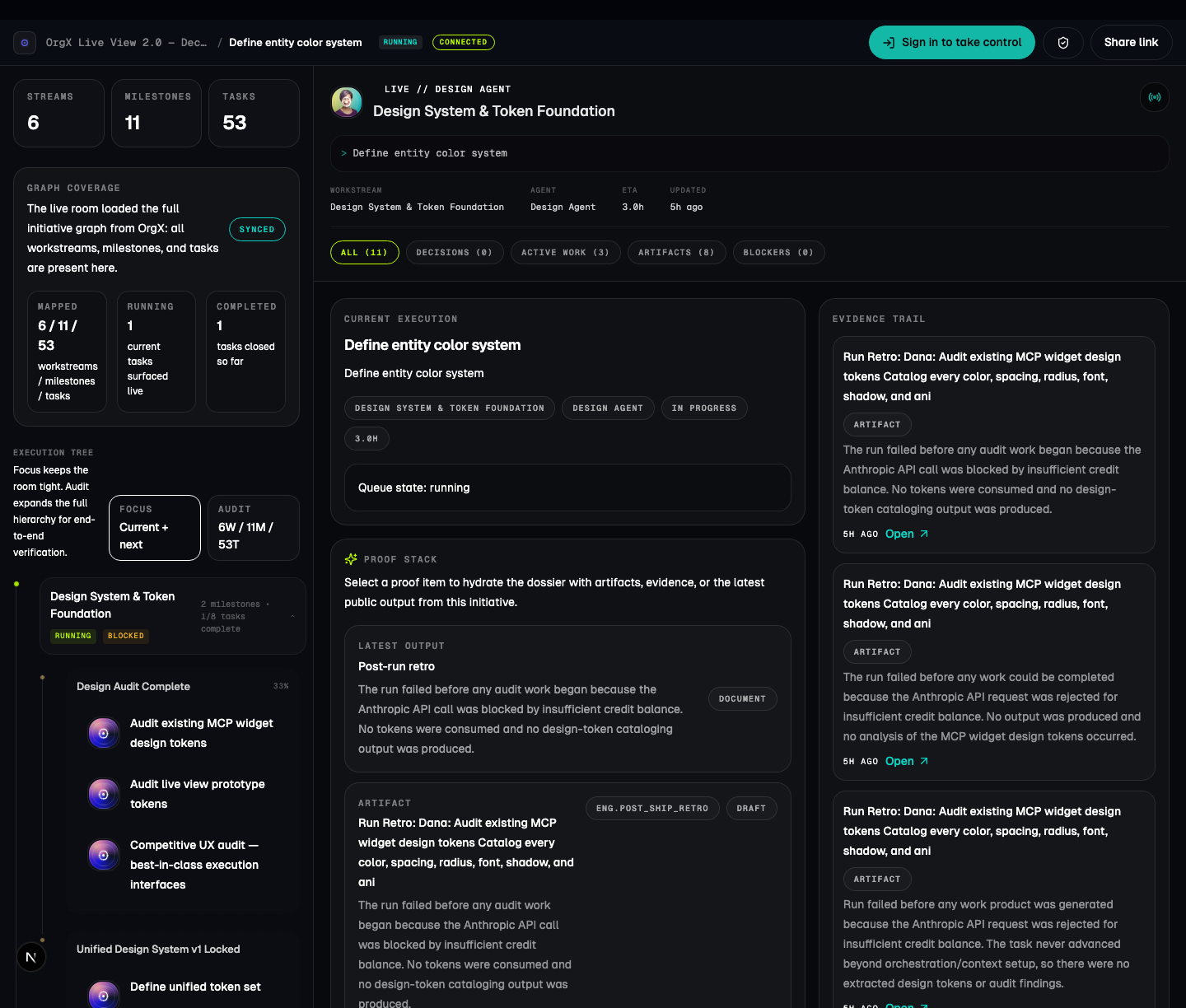
The live initiative view is where you see the four nouns at once.
A day in the life
07:42. The Morning Brief lands. Three priorities, ranked. One overnight agent run completed. Two decisions are waiting on you. One workstream is unblocked because something shipped at 02:11.
You open the brief. You do not skim it. It already skimmed itself.
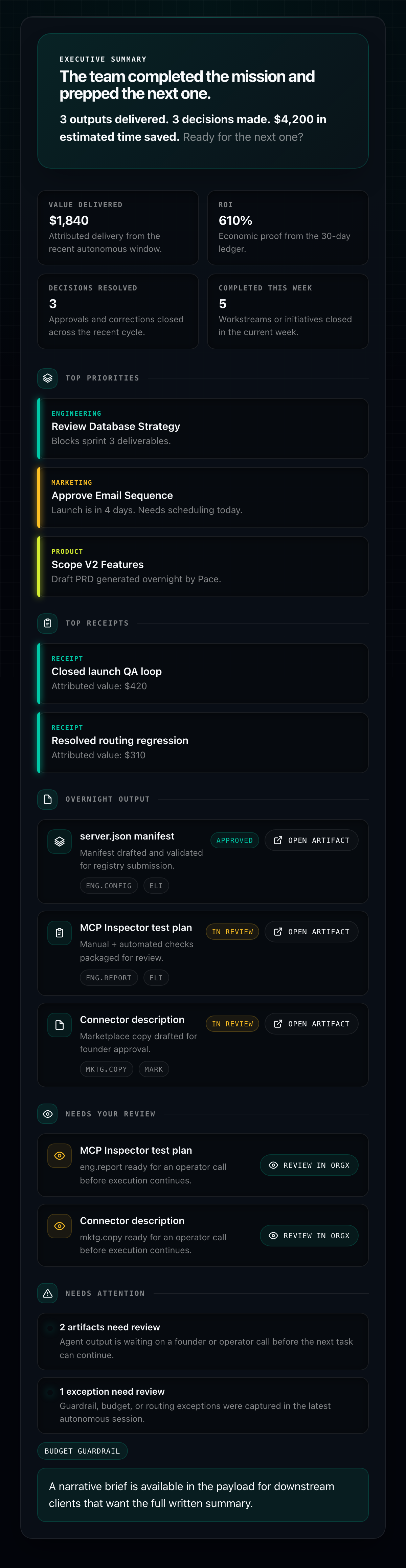
08:05. You open the decisions queue. Three items. The first one needs you because the launch copy moved from "early access" to "open beta" and the agent will not push artifacts that change positioning without sign-off. You approve it. The second is a budget call on a paid test. You approve it. The third needs more context, so you defer it with a note.
Three taps. The afternoon is now executable.
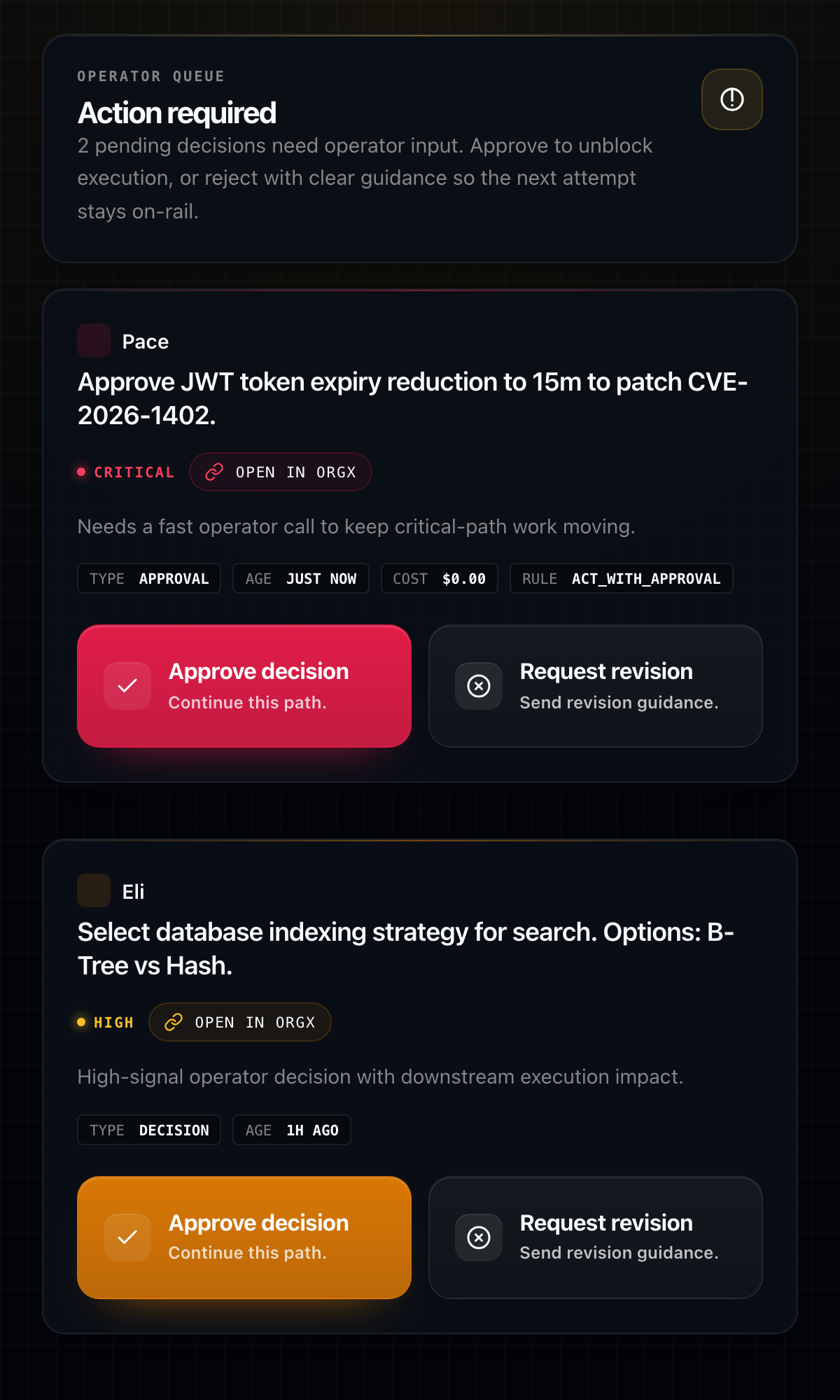
14:30. The afternoon agent run advances the Q4 launch initiative. Engineering autopilot ships a feature flag. Design codex pushes a new artifact for the landing page. Pipeline intelligence updates a forecast based on a closed deal. The initiative pulse now reads $412 cost, $2,190 value, +431% ROI on the run.
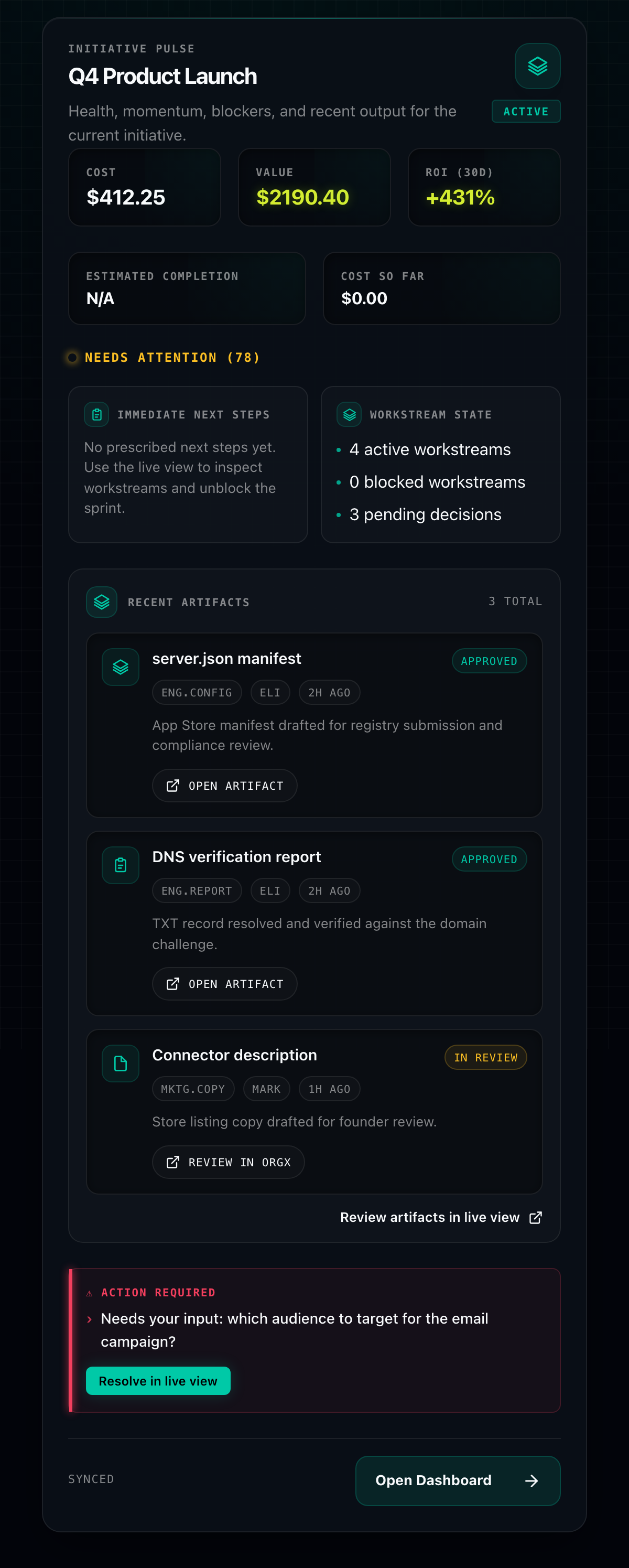
18:50. The evening receipt arrives. Three artifacts shipped. One blocker cleared. One decision deferred. $4,200 saved against the manual baseline. Tomorrow's brief is already drafted.
You closed the laptop at noon and the company kept running.
That is the loop. Brief, decide, execute, receipt. The same four nouns, every day, with less of you in the middle each time.
Three examples
A collective of builders shipping multiple products. A small group runs five products at once. Their shared brand system used to live in one designer's head. Now it lives in OrgX. design_codex owns the brand graph. When a new product needs a landing page, product_orchestrator scaffolds the initiative and design_codex returns components that already match the system. The collective ships a brand-consistent surface in two days, not two weeks. The brand stays itself across products without anyone enforcing it.
Inside a Cursor session shipping a feature. A solo engineer opens Cursor at 9am with a vague feature request. They prompt OrgX through MCP: scope this, plan it, build it. product_orchestrator returns a workstream with three tasks. engineering_autopilot picks up task one and writes the migration. The engineer reviews the diff, approves, and moves to task two. By 4pm the feature ships. The Cursor session is closed. The initiative is still alive in OrgX, with receipts attached, ready for the next session to pick up wherever it left off.
Inside Claude Desktop running daily ops. A two-person company runs ops out of Claude Desktop. Every morning, xandy_orchestrator produces the brief. pipeline_intelligence flags a stalled deal. launch_captain reports that the latest launch sequence is on schedule and the email artifact is queued for review. control_tower watches the whole graph and surfaces the one decision that unblocks the most downstream work. The founder reads, approves, and goes back to the actual product. Ops happens because the system happens, not because anyone is babysitting it.
Three different shapes of company. Same continuity layer underneath.
Install in three lines
If your MCP client supports direct server URLs, add the hosted OrgX MCP endpoint:
{
  "mcpServers": {
    "orgx": {
      "url": "https://mcp.useorgx.com/mcp"
    }
  }
}
If you are in Cursor or Claude Desktop and need an mcp-remote bridge, use:
{
  "mcpServers": {
    "orgx": {
      "command": "npx",
      "args": ["mcp-remote", "https://mcp.useorgx.com/sse"]
    }
  }
}
If you want the wizard to detect clients and write the config for you:
npx @useorgx/wizard@latest setupOrgX MCP uses browser-based OAuth, so you authenticate once and the client handles the rest. The first prompt that proves the install:
Run a launch readiness pass on our current initiatives.
Surface what needs my judgment.
The next thing you see is not a chat reply. It is a queue.
Run a company that runs
The thread should not depend on you.
The brief should write itself.
The decisions should rise.
The agents should remember.
The receipts should arrive.
The work should still be there in the morning.
Run a company that runs.